Exhibit
COMMERCE, CONNECTION & CULTURE
Feature Exhibit, Figh-Pickett House
June 3rd through September 2nd
9 a.m. to 4 p.m. Monday through Thursday
Our second exhibit of the year, Commerce, Connection & Culture, aims to honor and amplify the story of the River Region’s Indigenous people in recorded history, fostering a greater appreciation of the era, the landscape, the individuals, and their roles in our region’s history.
With every exhibit, we strive to spark interest in Montgomery’s history and motivate members and visitors to explore local and regional historical sites and attractions
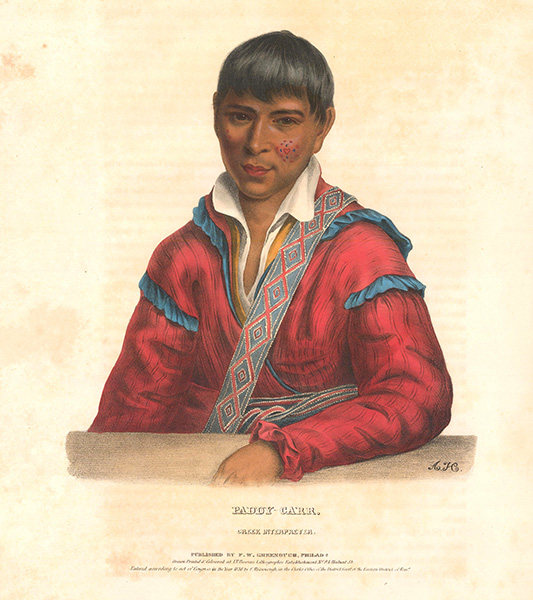
Paddy Carr
Charles Bird King, Paddy Carr Creek Interpreter from History of the Indian Tribes of North America, ca. 1838, hand-colored lithograph on paper
Paddy Carr was a skilled linguist born in Alabama to an Irish father and a Creek mother.
In 1826, he served as an interpreter for the Creek delegation to Washington.
MCHS thanks the following friends and partners for exhibit contributions and temporary loans: Mr. Jeff Dutton, Dr. Elijah Gaddis, Mr. Tim Goode, Mr. John J. Gurner, Park Director and Site Historian, Fort Toulouse-Fort Jackson, Collier Neeley, Director, The Landmarks Foundation, Ms. Tori Jackson, Dr. Mark Wilson, Director, Pebble Creek, and the Poarch Band of Creek Indians.
Much of the research and information for this exhibit came from the Encyclopedia of Alabama & Porch Creek Indians
EXHIBIT PROGRAMS & EVENTS
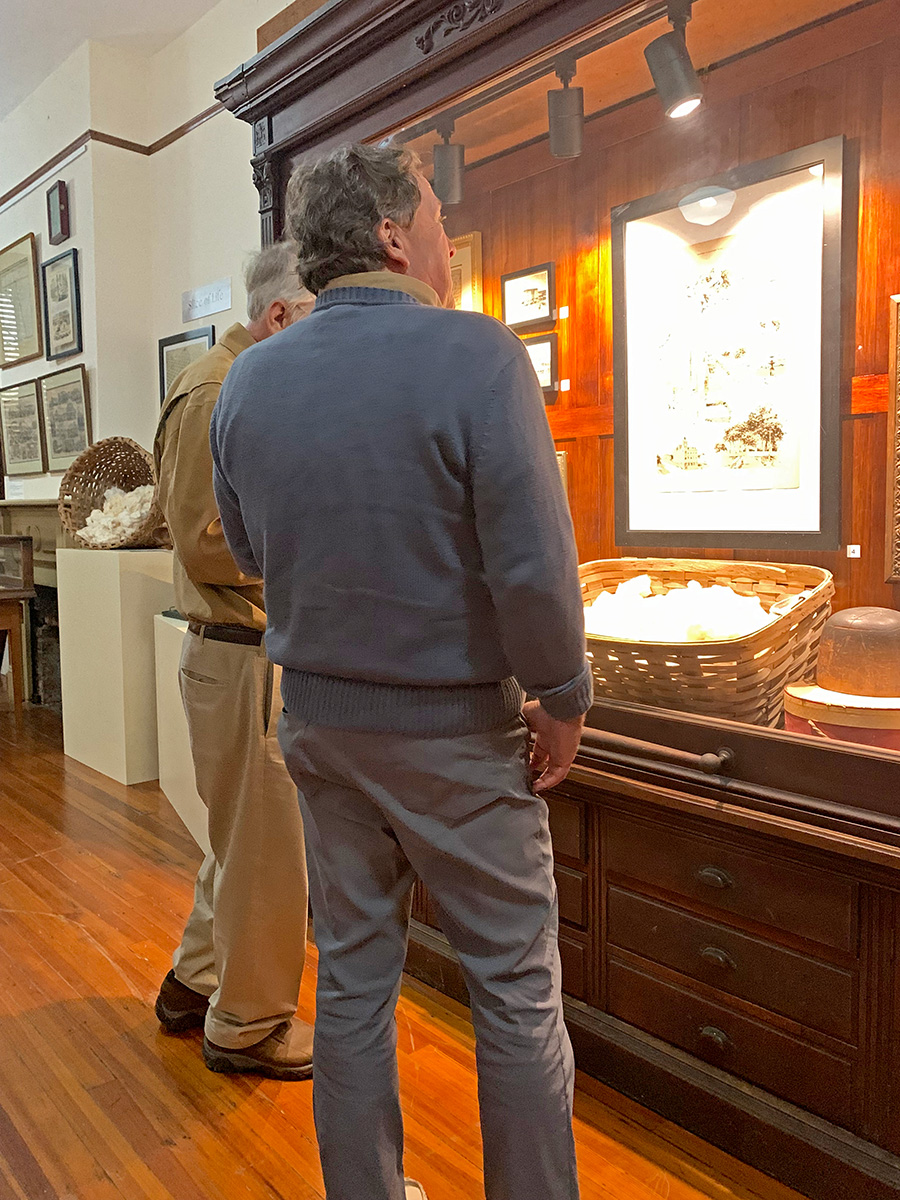
Annual Membership Meeting
Thursday, June 12th
4 – 5 p.m. (open to members)
Feature Exhibit Opening Reception
Thursday, June 12th
5 – 6:30 p.m. (open to members and the public)
Brown Bag Lunch and Learn
Wednesday, July 16th
11:30 a.m. – 1 p.m.
Guest Speaker: John J. Gurner, Site Historian, Fort Toulouse-Fort Jackson Park (in conjunction with the feature exhibit)
TRADITIONAL CREEK (MUSCOGEE)
Identity, Towns & Structure
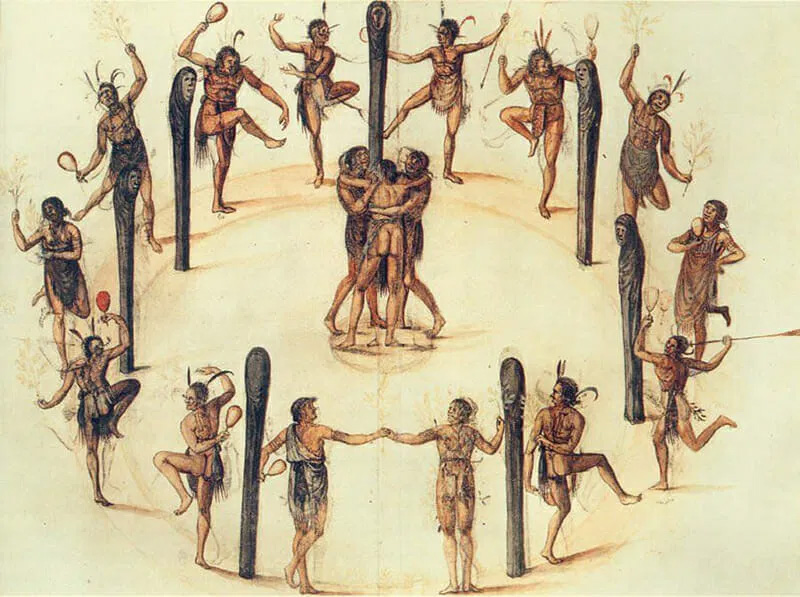
Green Corn Ceremony
Encyclopedia of Alabama, Program of Auburn University Outreach, 2025 Alabama Humanities Alliance, Green Corn Image, Courtesy of the British Museum.
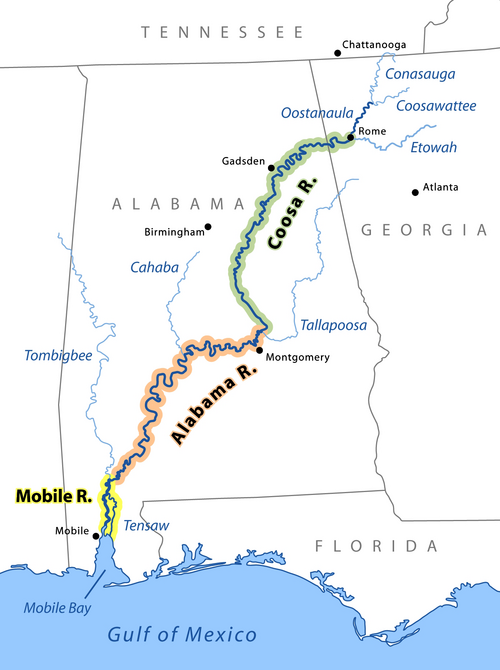
Confluence of the Coosa and Tallapoosa Rivers Near Montgomery
Wikipedia, Coosa River, 12 Dec 2006; Version 3: 6 May 2007.
The Creek Indians, along with the Choctaws and Cherokees, are descendants of the Mississippian peoples (ca. AD 800-1500).
The arrival of Europeans in the 16th century led to devastating epidemics and conflicts, scattering Indigenous populations. By the 17th century, these groups began to settle along the Chattahoochee, Tallapoosa, and Coosa Rivers in present-day east-central Alabama, forming new towns that became centers of Creek life.
In the late 1700s, the center of the Creek Nation was located at the confluence of the Coosa and Tallapoosa Rivers near Montgomery.
The Creeks established significant towns that served as political centers and were integral to communal identity. The nation was divided into Upper Creeks who resided along the Coosa, Alabama, and Tallapoosa Rivers, and the Lower Creeks along the Chattahoochee, Ocmulgee, and Flint Rivers, which were connected by trade routes.
Each group was identified mainly by its central regional town. The term “Creek” originated from English traders labeling various towns. The Creeks saw themselves as a confederacy with three main groups: the Ochese (also known as the Coweta), the Tallapoosa, and the Abeika. British and American outsiders referred to the Coweta as “Lower Creeks” and the other two as “Upper Creeks.”
Creek kinship terminology distinguished towns by perceived age or population size, designating older towns as “grandmother towns” and newer ones as “daughter towns.” They categorized towns as “war” (red) or “peace” (white) towns, allowing them to act independently in diplomacy and warfare under dual civil and military leadership. Prominent groups included the Coweta, Cusseta, Tuckabatchee, and Abeika, with leaders from Tuckabatchee, Okchai, Okfuskee, Talassee, and Abeika often dominating political affairs in east-central Alabama.
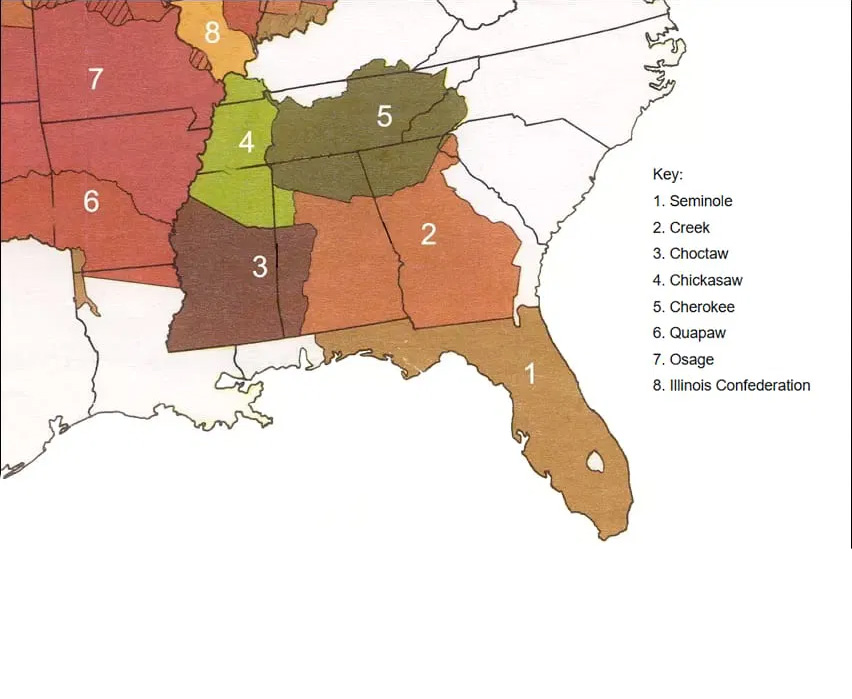
Indigenous Lands Map
Encyclopedia of Alabama, Program of Auburn University Outreach, 2025 Alabama Humanities Alliance, Indigenous Lands Map, Courtesy of the U.S. National Park. Service
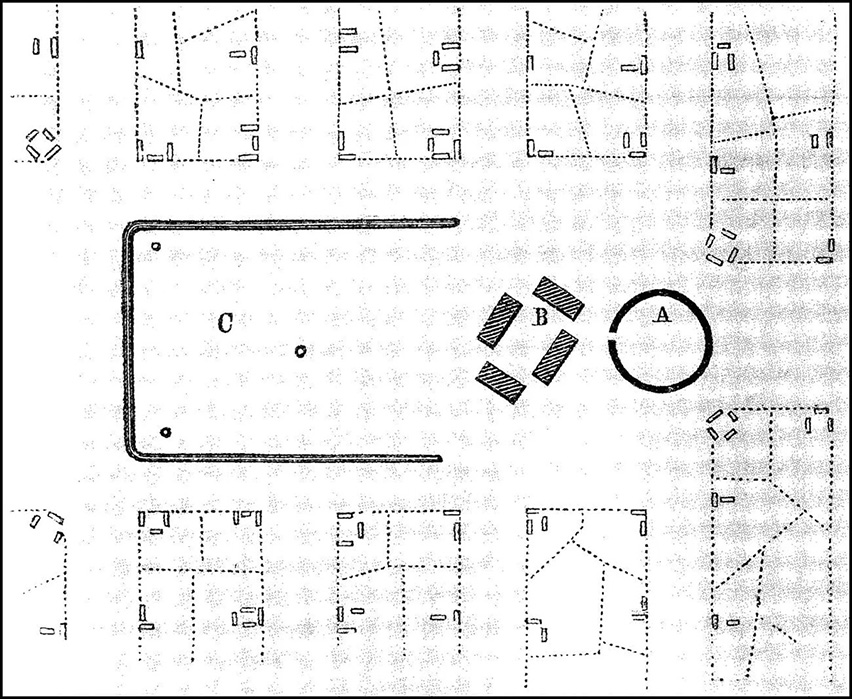
Creek Town Layout
Encyclopedia of Alabama, Program of Auburn University Outreach, 2025 Alabama Humanities Alliance, Engraving of Creek Town Layout.
Creek towns were typically divided by a creek or river, with fields on one side and residences on the other. Key features included a town square with an open area surrounded by terraces, a circular mound with a rotunda, and a public square used for ceremonies and games. Residential buildings in Creek towns mirrored the layout of the public square. Family compounds typically included up to four houses surrounding a courtyard, depending on family size. These buildings featured wooden frames set in the ground, lath-wrapped and plastered with clay, and roofs made of bark or grass. By the late 19th century, some Creek houses had chimneys and were constructed from logs, resembling the homes of European settlers.
THE FEDERAL ROAD
Commerce & Connection
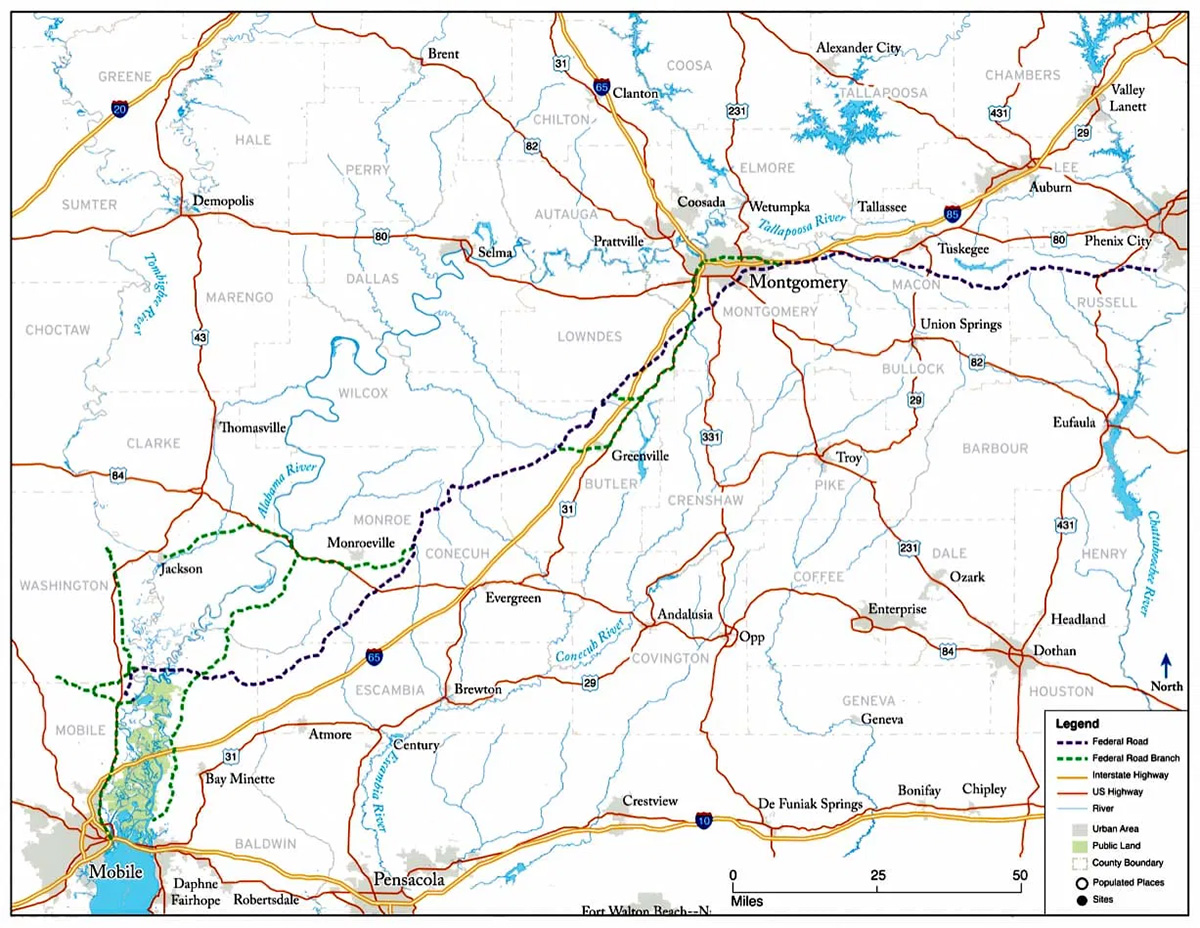
Federal Road Map
Encyclopedia of Alabama, Program of Auburn University Outreach, 2025 Alabama Humanities Alliance, Courtesy of the University of Alabama Press. From The Old Federal Road in Alabama: an Illustrated Guide (2019) by Kathryn H. Braund, Gregory A. Waselkov, and Raven M. Christopher.
Originally designated as a postal route in 1806, the old Federal Road stretched through the Creek territory of lower Alabama. Alabama’s Federal Road functioned as a major thoroughfare for western migration into the Old Southwest, ushering in a new era of national expansion and exploitation of Native American territory.
In 1811, as tensions with Great Britain escalated, the U.S. government expanded a 16-foot military road to support the movement of troops and supplies westward for defense against a potential British attack. Completed in November 1811, this road connected Milledgeville, Georgia, to Fort Stoddert and New Orleans and intersected with an earlier postal route. However, increased traffic heightened tensions between white settlers and the Creek people, leading to the Creek War of 1813-14 and the eventual removal of the Creeks from their homeland.
The Federal Road’s importance was further emphasized by the construction of forts like Fort Mitchell as the American army confronted the Red Stick faction. Post-war, it became vital for settlers moving into the Mississippi Territory, where plantation agriculture and nearly one million enslaved African workers transformed the economy into a cotton-based one.
The rise of steamboats and railroads reduced travel along the Federal Road, which further declined during the economic troubles of 1837. By 1844, Samuel Morse’s telegraph invention reduced the need for these routes. While much of the Federal Road has disappeared, sections remain in Alabama, especially in Macon, Monroe, and Conecuh Counties.
Influential Leaders of the Time
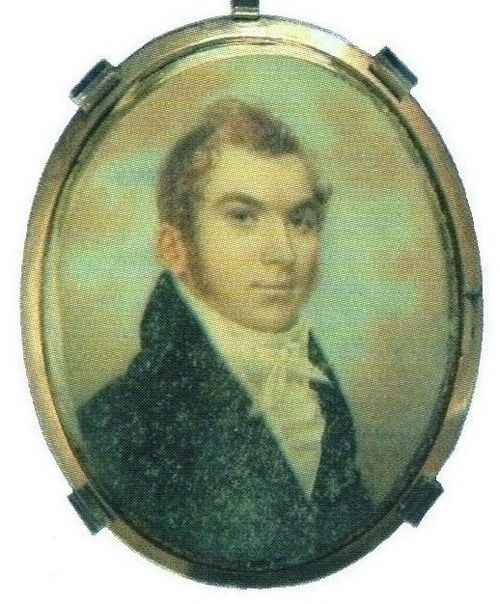
Chief Alexander McGillivray
Wikipedia, This portrait of Alexander McGillivray, or Hopothle Mico (1750–1793), is contained in a silver locket, 24 December 2013
Chief Alexander McGillivray was born Hoboi-Hili-Miko (Good Child King) in the Coushatta village of Little Tallassee (also known as Little Tallase, Little Talisi, and Little Tulsa) on the Coosa River, near present-day Montgomery, Alabama, on December 15, 1750. McGillivray became the principal chief of the Creek Indians in the years following the American Revolution. He was largely responsible for the Creeks’ retention of their tribal identity and the majority of their homeland for another generation.
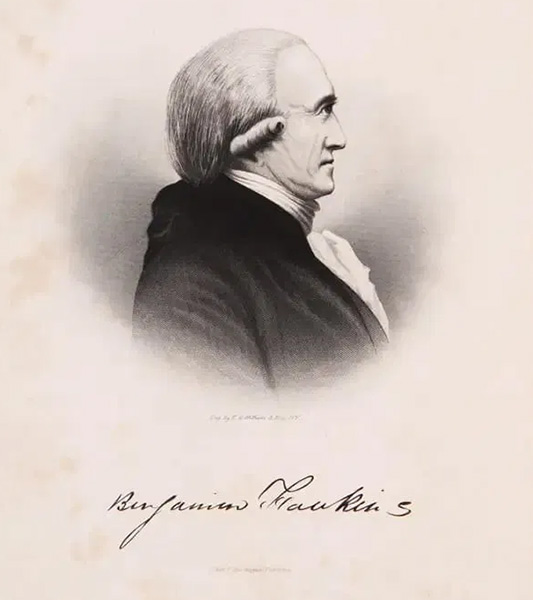
Benjamin Hawkins
Encyclopedia of Alabama, Program of Auburn University Outreach, 2025 Alabama Humanities Alliance, Benjamin Hawkins Image.
Benjamin Hawkins (1754-1816) was the U.S. government’s main agent to Southeastern Indians from 1796 until his death. Unlike many federal agents, he lived among the Creeks, learned their language, and was honored as “Beloved Man.” Hawkins negotiated treaties and accompanied federal survey teams in the region.
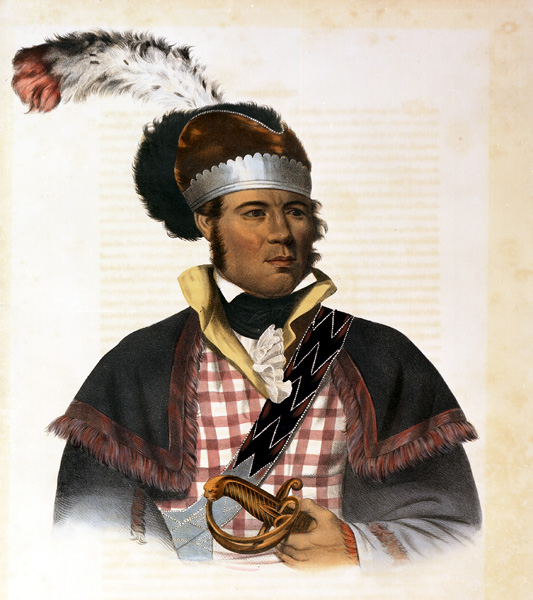
William McIntosh
Charles Bird King, William McIntosh (1775 – 1825) from History of the Indian Tribes of North America, ca. 1838, hand-colored lithograph on paper.
William McIntosh, also known as Tustunnuggee Hutke, was a prominent chief of the Muscogee Creek Nation during the early 19th century until his execution in 1825. He served as the chief of the Coweta tribal town and was the commander of a mounted police force.
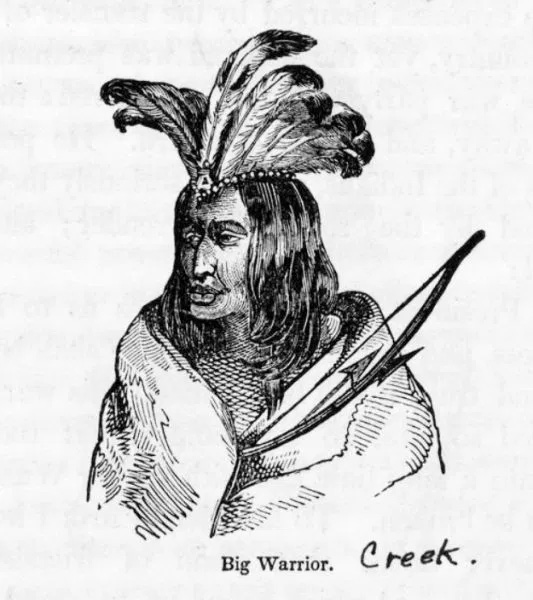
Tustanagee Thlucoo
Encyclopedia of Alabama, Program of Auburn University Outreach, 2025 Alabama Humanities Alliance, Tustanagee Thlucoo Image, Courtesy of the New York Public
Tustanagee Thlucoo, known as “Big Warrior,” was the headman of the Upper Creeks in Tuckabatchee and a key member of the Creek National Council from the early 1800s until his death in 1825. He served as the spokesperson for Upper Creek towns and supported U.S. efforts to assimilate Native Americans into European ways of life.
Post-American Revolution through Early 19th Century
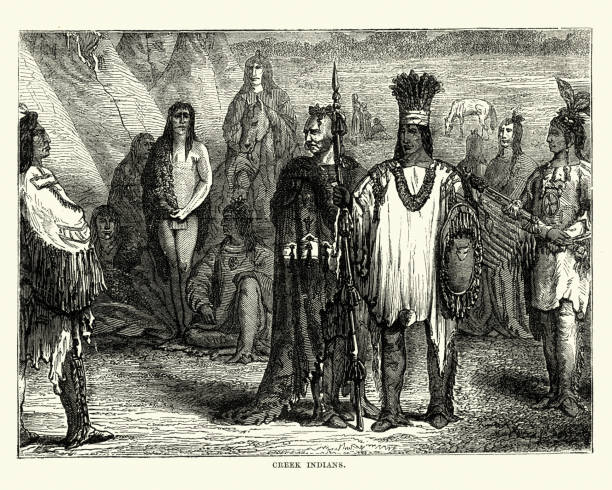
Following the American Revolution, one of the most influential Creek leaders was Alexander McGillivray, the son of a Scottish trader and a Creek mother. McGillivray was instrumental in encouraging cooperation among the various Creek towns and courting the assistance of the Spanish in Florida to help the Creeks defend their land against the Americans. The U.S. government pressure proved too much to bear, and the Creeks ceded their remaining Georgia lands in treaties negotiated between 1790 and 1805. The Creek began to resemble the plantation economies of the Lower South, as many Creeks (often the bi-cultural sons of Scottish fathers and Creek mothers) began introducing cotton and plantation slavery into the region.
In an effort to assimilate southeastern Indians, the U.S. government enacted a plan in 1796, known as the Plan of Civilization, and placed Indian agent Benjamin Hawkins in charge. Under the plan, the Creeks and other southeastern tribes were to receive instruction in commercial farming, animal husbandry, cloth spinning, and the principles of Christianity. Hawkins also attempted to centralize the Creek government by creating a police force, a Creek National Council, and by encouraging the creation of written laws.
Many Creeks accepted the new order brought by U.S. expansion, with leaders like William McIntosh and Big Warrior benefiting from the new economy and forming alliances with U.S. agents. They opened taverns and stage stops along the Federal Road connecting Fort Mitchell to Mobile. In contrast, traditionalist Creeks, concerned about their sovereignty as white settlers flooded into Alabama Territory, began to resist. Led by figures like Josiah Francis and inspired by Tecumseh’s pan-Indian movement, they initiated the Creek War, also known as the Red Stick revolt, against U.S. forces and rival factions. After early successes, the Red Stick Creeks, led by Menawa, were ultimately defeated by Gen. Andrew Jackson at the Battle of Horseshoe Bend in 1814. The Treaties of Fort Jackson (1814) and Indian Springs (1825) forced the Creeks to cede their land in Georgia and relocate to Alabama. McIntosh, who signed the Indian Springs treaty, was seen as a traitor and was executed by the Creek National Council.
In 1830, the Indian Removal Act authorized the relocation of southeastern tribes to Indian Territory, now known as Oklahoma. While some Creek leaders supported removal for self-preservation, most opposed leaving their ancestral lands. As white squatters invaded, Creek leaders like Opothle Yoholo went to Washington to defend their rights, but felt it was futile. On March 24, 1832, they signed the Treaty of Cusseta, agreeing to removal in exchange for land grants. After a failed rebellion in 1836, the U.S. government forcibly removed them. Opothle Yoholo led many west, while others evaded removal or accepted land allotments, forming the Poarch Band of Creek Indians in Alabama.
Old Taverns Along the Federal Road, Montgomery County
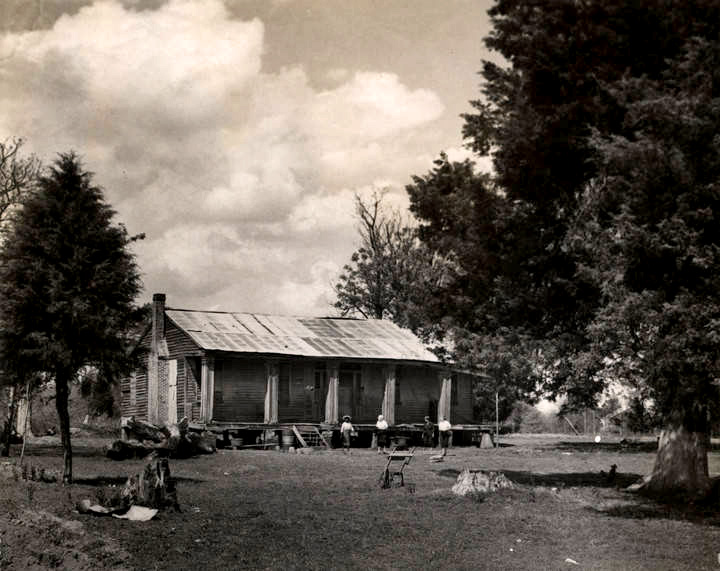
Lucas Tavern
Alabama Department of Archives and History, Lucas Tavern in Waugh, Alabama, located on the old Federal Road, 1950-1959, 9.5 x 7.5 photograph.
Lucas Tavern
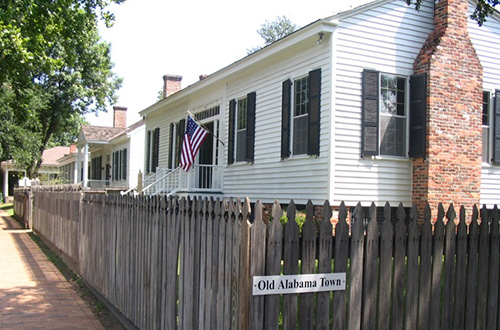
Lucas’s Tavern, located north of present-day Waugh and west of Line Creek, operated from around 1818 until 1842. Acquired by Walter and Eliza Lucas in 1820, it became known as “the most celebrated inn on the Federal Road” and hosted notable guests, including Lafayette in 1825. Initially, a two-room dogtrot, it expanded to four rooms after the hallway was enclosed. After Walter’s death, Eliza managed the tavern, serving meals for 75 cents and breakfast for 50 cents. The tavern declined due to reduced traffic on the Federal Road and was relocated to Old Alabama Town in Montgomery in 1978. It was then renovated and opened in 1980 as part of the “Living Block Tour.”
Old Milly’s Tavern
Known as Milly’s Stand and Evan’s Tavern, this establishment was located near Abraham Mordecai‘s house on Norcoce Chappo Creek, now Milly’s Creek, just east of present-day Mount Meigs in Montgomery County. Mordecai, an early cotton gin operator and one of the first Jewish residents in Alabama, is the primary source of information about Milly’s Tavern. Named after the widow of a British soldier who ran the tavern and a toll bridge, it operated until around 1820 and is mentioned in the account of Aaron Burr’s arrest in 1807. Later travelers would often journey to Montgomery to catch a steamboat to Mobile, leaving limited records of the Federal Road after Evan’s Tavern.
Bonham’s Tavern
Sometimes referred to as Bonham’s or Bonam’s, this tavern was located in present-day Montgomery County, approximately ten miles south of the capital in the unincorporated town of Snowdoun. It had been in operation since 1820 by he proprietor, Mrs. Bonham.
Sam Manack’s Tavern/Moniac’s Tavern
The tavern, established in 1808 by Creek Indian Sam Manack (or Moniac) in west-central Montgomery County near Pinchona Creek, was one of the first licensed taverns on the Federal Road. Known as Sam Manack’s House, it served as a stop for postal workers and later gained popularity with the U.S. Army. After David Moniac, the son of Sam, took over, he became one of the first indigenous graduates of West Point but was killed in the Second Seminole War. In 1813, Gen. James Wilkinson visited to write a letter about the Creek War. The tavern was destroyed during the war but was rebuilt with government compensation. By 1819, however, it had been abandoned.
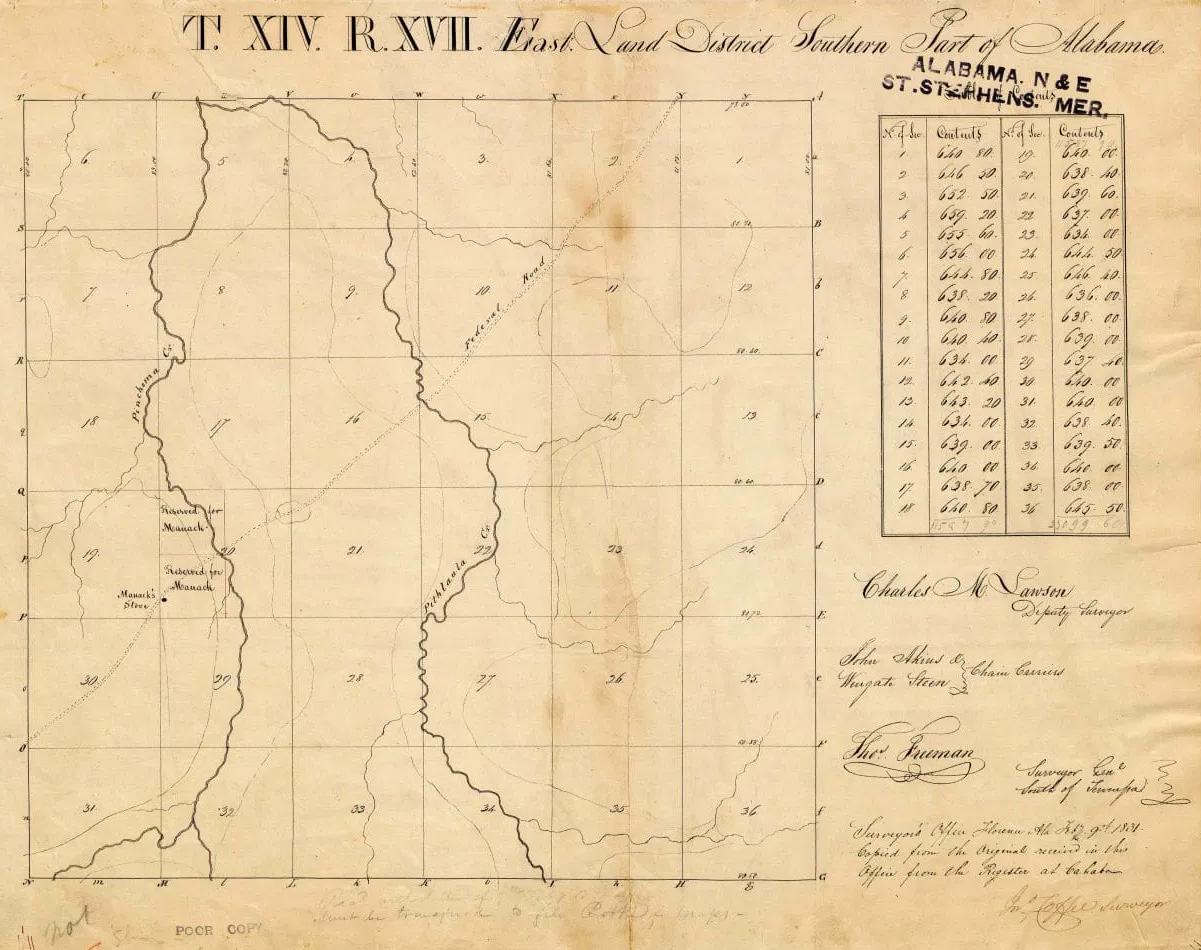
Encyclopedia of Alabama, Program of Auburn University Outreach, 2025 Alabama Humanities Alliance, Courtesy of the U.S. Bureau of Land Management, General Land Office.
TRADITIONAL CREEK (MUSCOGEE) CULTURE
Matrilineal System and Clan Structure:
- Matrilineage: Children inherited their clan membership from their mother, not their father.
- Clan Significance: Clans were the primary social units, with members living, farming, and hunting together.
- Matrilocal Residence: Husbands joined their wives’ households, strengthening clan ties.
Agriculture: Cultivated corn, beans, squash, pumpkins, and tobacco.
Hunting: Men hunted deer, bear, and other animals for food and trade.
Spirituality: Believed in good and evil spirits that communicated with people.
Language: Spoke the Muscogee language, part of the Muskogean family.
Trade: Traded buckskins for guns, altering hunting practices.
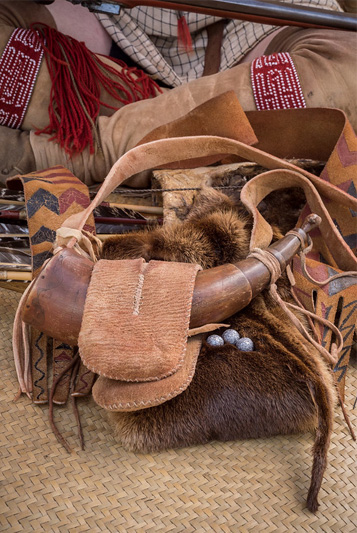
Clothing: The men wore breechcloths, small squares of deerskin that hung down like a skirt, and leather leggings. They had mohawks and tribal tattoos. The women wore wrap-around skirts made of deerskin and woven fabric.
Ceremony: The Green Corn Ceremony, also known as the busk from the Creek word poskits, meaning “to fast,” was the most significant of the various annual traditional ceremonies performed by Indian tribes in the Southeast. Most Indian groups in the region likely practiced a version of this celebration, which took place in midsummer when the early corn was ripe. The annual renewal ceremony typically lasted either four or eight days, with fasting being only one of the involved rituals. Feasting and acts of social and material renewal also played a vital role. Anthropologist Charles Hudson noted that modern Americans would need to combine Thanksgiving, New Year’s Day, Yom Kippur, Lent, and Mardi Gras to have a holiday that matched the scope and significance of the Green Corn Ceremony.
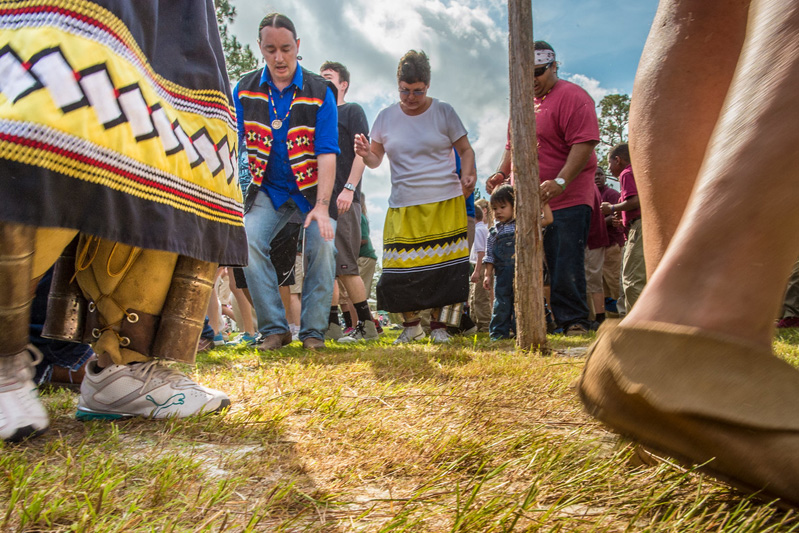
Stomp Dance: Stomp dances are typically performed several times a year during the summer months and are scheduled according to a ritual calendar specific to each community and its ceremonial grounds. The Stomp Dance itself is a group dance that includes both men and women. In each performance, a man is chosen to lead the singing for one round of dancing. The leader may be selected for his singing ability or to honor the visiting ceremonial ground he represents.
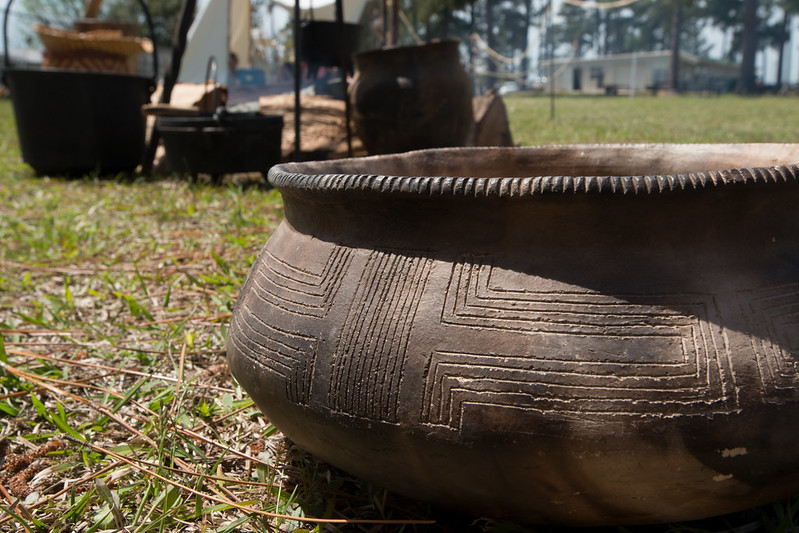
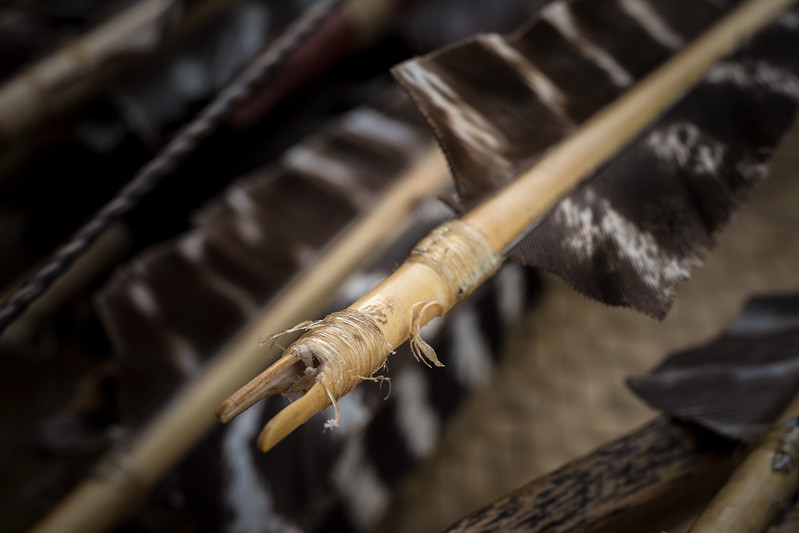
Arts: Valued storytelling, music, and art, with participation from both genders. Women were primarily responsible for weaving and pottery, while men worked with metal and wood. Their art often incorporated elements of nature and was used in ceremonial practices, featuring notable items such as feather dance wands and headdresses.
Modern Preservation
The Poarch Creek Indians are the only federally recognized Indian tribe in Alabama, with 2,340 members who primarily reside on a 230-acre reservation in Escambia County. They operate as a sovereign nation with their own government and bylaws. They actively preserve their cultural heritage through a museum that showcases traditional art, teaching workshops in crafts such as basket weaving and quilting, and hosting cultural events. The Poarch Creek Indians Museum displays artifacts, including original petitions for federal recognition, traditional pottery, baskets, textiles, shellwork, and contemporary art by Creek artists. Once marginalized and impoverished, they now manage multiple gaming facilities in partnership with the state, contributing to the economic and cultural development of their members and surrounding communities.
ABRAHAM MORDECAI
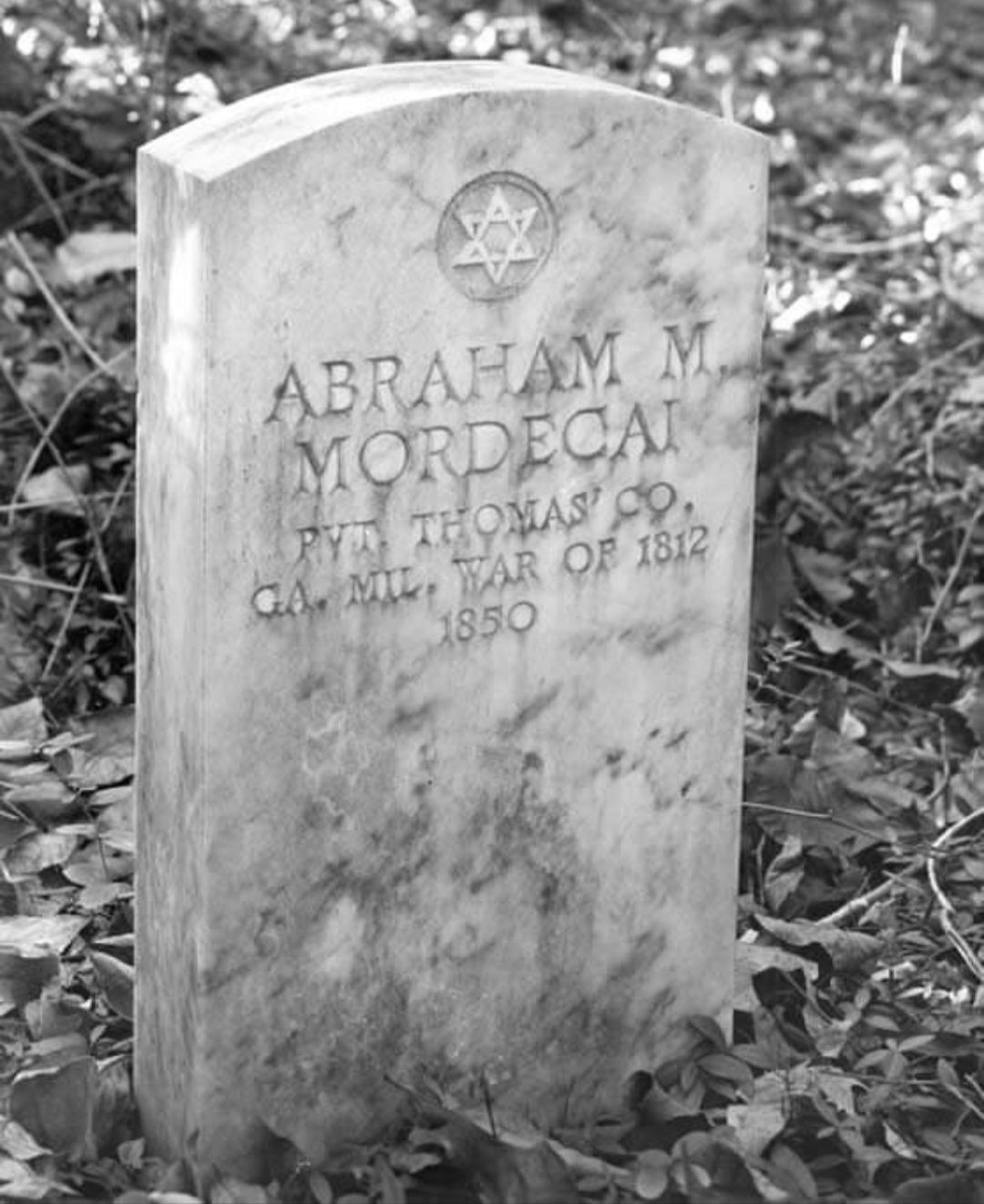
Mordecai Headstone
Encyclopedia of Alabama, Program of Auburn University Outreach, 2025 Alabama Humanities Alliance, Photo courtesy of Ginger Ann Brook.
Abraham Mordecai (1755-1850) was likely the first Jewish resident of Alabama and an early white settler in the southeastern United States. He participated in significant events that shaped the region, including the American Revolution, the War of 1812, and the Creek War. In 1783, Mordecai established a trading business at Line Creek (present-day Alabama) and acted as a negotiator between the Creeks and government agents, trading various goods. He married a Creek woman, believing that Native Americans descended from one of the fabled Lost Tribes of Israel. Many sources indicate that he initially tried to communicate with the Creeks in Hebrew, believing their language was a dialect of the Hebrew language. He became known among the Creeks as Muccose, also known as Little Chief.
In 1785, Mordecai moved with his family to the Creek town of Econochaca (also known as Holy Ground), along the banks of the Alabama River, in present-day Montgomery. He again set up a trading business among the nearby Creeks and Choctaws, being one of the few non-Indians in the area at the time. In the 1790s, the federal government initiated what was known as the “Plan of Civilization,” which aimed to encourage Native Americans to give up hunting and gathering and adopt farming and manufacturing as their livelihoods, with the ulterior motive of acquiring their vast hunting lands. In 1802, Mordecai was enlisted to establish a cotton gin near the Creek towns along the Alabama River, in present-day Montgomery County. The gin was built just below the confluence of the Coosa and Tallapoosa Rivers, along a trading path that would become part of the route of the Federal Road, near a racetrack owned by Creek leader Charles Weatherford (father of future Red Stick Creek leader William Weatherford) and a tavern known as Milly’s Stand and Old Milly’s Tavern.
During the War of 1812, he served in the Georgia Militia and later led U.S. troops during the Creek War. In a notable battle in 1813, he played a key role in defeating the Red Stick faction of the Creeks. Following the war, he continued his career as a cotton broker until the federal government removed the Creeks from their land in 1836, but as a white man, Mordecai remained. Some reports suggest his wife and children moved to Arkansas and then Oklahoma, while others claim his wife had died by 1836 and the children had left the area. He then relocated to Dudleyville, where he owned a store and became a well-known storyteller.
In his final years, Mordecai lived a simple life and reportedly made his own coffin in advance. He died on August 25, 1850, and was buried in an unmarked grave. The Daughters of the American Revolution later placed a granite marker on his grave in 1933 in honor of his service.
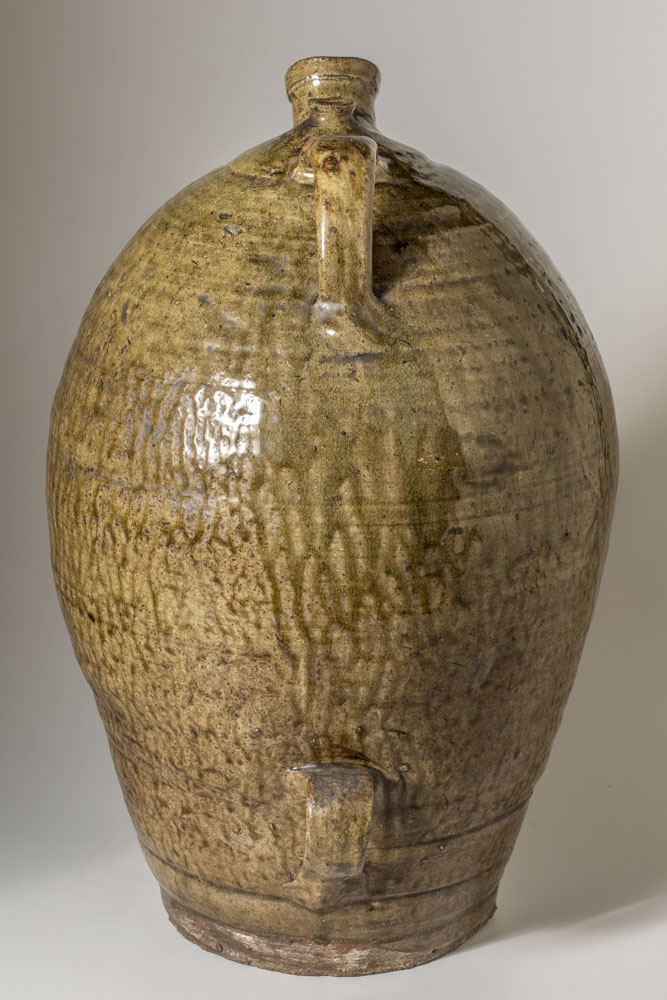
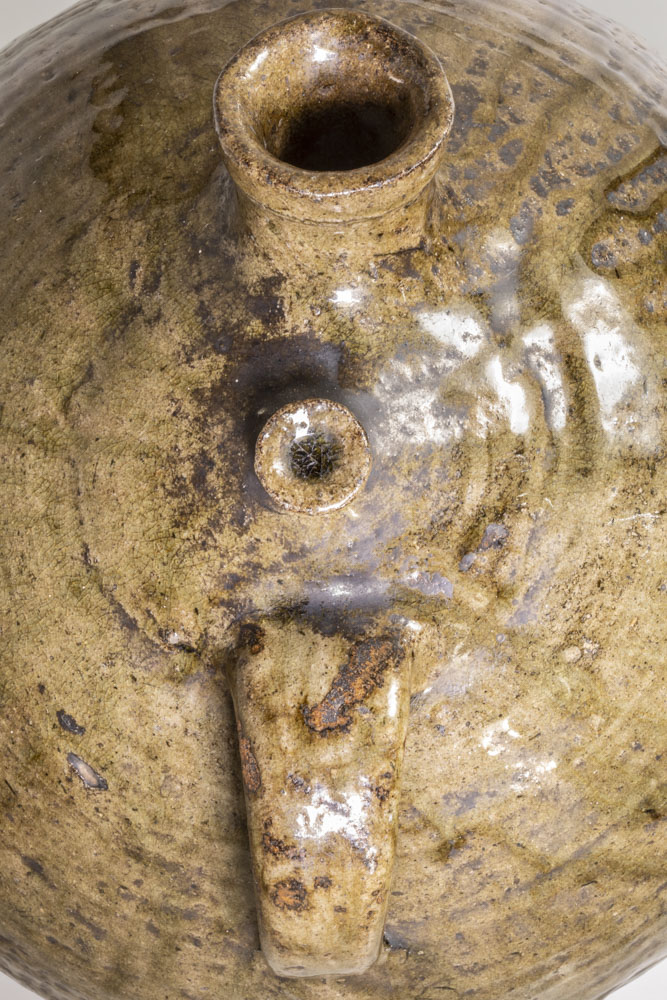
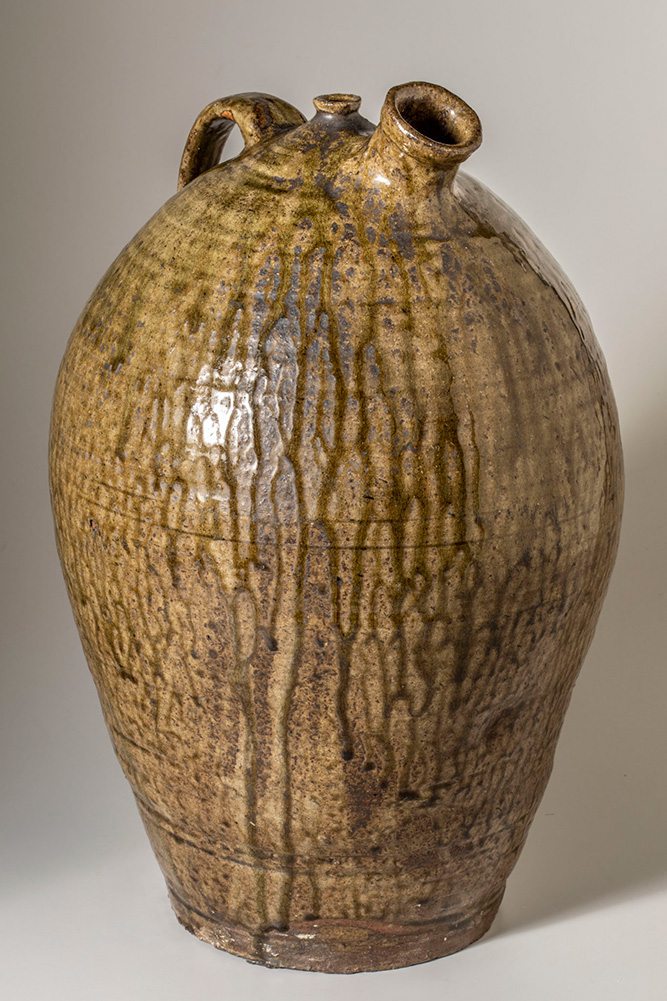
Monkey Jug, circa 1840, Five-gallon stoneware with ash-based alkaline glaze.
“Monkey Jug” is a folk term for a side-spouted vessel used to hold anything from water to whiskey. According to tradition, Mordecai used the jug to store whiskey, which he sold to the Muscogee (Creek Indians).
Abraham (or Abram) Mordecai was the original owner of the jug. The ownership of the jug has changed several times over the years. It was purchased by Dewie Willoughby Fuller, who later gave it to historian Peter Brannon for his collection. When Brannon retired as the Director of the Alabama Department of Archives and History, he returned the jug to the Fuller family. Subsequently, the Fuller family donated the jug to the Montgomery County Historical Society’s collection.
Peter Brannon described the Monkey Jug in a Montgomery Advertiser December 1933 article, “The jug is of a short five-gallon capacity and clearly made by the ‘coil process,’ that is, the old manner of forming earthenware objects before the invention of the potter’s wheel. It is streaked glazed, indicating that salt was poured into the damp clay before firing took place. It has no mouth or neck but a spout opposite the two handles, both of which are on the same side of the vessel.”
WORD SEARCH

Word Search: Things to Know
Old Federal Road: Originally designated as a postal route in 1806, the old Federal Road stretched through the Creek Indian territory of lower Alabama. Alabama’s Federal Road functioned as a major thoroughfare for western migration into the Old Southwest, ushering in a new era of national expansion and exploitation of Native American territory.
Alabama River: The Alabama River, located in the U.S. state of Alabama, is formed by the Tallapoosa and Coosa rivers, which converge approximately 6 miles north of Montgomery, near the town of Wetumpka. Over about 319 miles, the river meanders westward toward Selma, then southwest until, roughly 45 miles from Mobile, it joins the Tombigbee, forming the Mobile and Tensaw rivers, which flow into Mobile Bay.
Lucas’s Tavern: Built around 1818, Lucas’s Tavern was described as “the most celebrated inn on the Federal Road.” Today, it is situated at Old Alabama Town in Montgomery and is part of the Living Block tour.
Old Milly’s Tavern: Located near Abraham Mordecai’s house on Norcoce Chappo Creek, later known as Milly’s Creek, just east of present-day Mount Meigs in Montgomery County, Mordecai is remembered as an early cotton gin operator, trader, translator, and settler in the area, and perhaps one of the first Jewish residents of the state. He serves as the primary source of information on Milly’s Tavern, named for the widow of a British soldier who operated a tavern and a toll bridge before later marrying Evans. Milly’s Tavern continued operations until around 1820. Subsequently, travelers often proceeded to Montgomery to catch a steamboat for Mobile, leaving behind few accounts of the Federal Road after Evan’s Tavern.
Bonham’s Tavern: Located in present-day Montgomery County, ten miles south of the capital in the unincorporated town of Snowdoun, it was in operation by 1820. The proprietor, Mrs. Bonham, was described by traveler James Stuart as “the worst-tempered female in America.” He noted that she often refrained from serving food at all until the moment the stage was set to arrive. Unwilling to delay the stage, guests either hurriedly ate or left their meals to go cold.
Manack Tavern: This tavern was established in 1808 by Creek Indian Sam Manack (also known as Moniac) in present-day west-central Montgomery County, near Pinchona (Pinchony) and Pintlala Creeks. It was among the first licensed taverns on the Federal Road. During the early days of the road, Sam Manack’s House served as a stop for postal workers to switch mounts and keep the mail moving.
Creek War: (July 22, 1813-August 9, 1814) The Creek War (also known as the Red Stick War or the Creek Civil War) was a regional conflict involving opposing Native American factions, European powers, and the United States during the early 19th century. The Creek War originated as a dispute within the Muscogee tribes, but the United States soon became involved. British traders and Spanish colonial officials in Florida provided the Red Sticks with weapons and equipment due to their mutual interest in preventing the United States from expanding into territories under their control.
Red Sticks: The name refers to a 19th-century traditionalist faction of the Muscogee Creek people in the Southeastern United States. Primarily composed of Upper Town Creek members, the Red Sticks advocated for traditional leadership, cultural preservation, and communal land for cultivation and hunting amid increasing pressure from European American settlers.
Upper Creeks: The Upper Creeks, or Red Sticks, were a faction of the Muscogee (Creek) Confederacy that opposed the United States in the Creek War of 1813-14. They were located mainly in northern Creek territory near the Coosa, Tallapoosa, and Alabama rivers.
Andrew Jackson: A key figure in the Creek War (1813-1814), he led American troops against the Creek Nation, achieving notable victories, including the Battle of Horseshoe Bend. The war concluded with the Treaty of Fort Jackson, in which the Creeks ceded vast lands in Alabama and Georgia.
Horseshoe Bend: The Battle of Horseshoe Bend, fought on March 27, 1814, was a pivotal conflict in the Creek War. It involved American and Native American allies led by Andrew Jackson against the Red Stick faction of the Creek Confederacy, who opposed U.S. expansion. The American victory ended the Creek War and led to the signing of the Treaty of Fort Jackson.
Abraham Mordecai: Mordecai (1755-1850) was likely the first Jewish resident of Alabama and an early white settler. He played a significant role in key events in the Southeast, including the American Revolution, the War of 1812, and the Creek War. Throughout his life, he served as a negotiator between the Creeks and government agents, a trader, and a military guide, and he helped establish the cotton industry around Montgomery.
Benjamin Hawkins: Administrator of the U.S. government’s plan of civilization, Benjamin Hawkins (1754-1816) served as the principal U.S. agent to Southeastern Indians from 1796 until his death in 1816. Unlike most previous federal Indian agents, Hawkins lived among the Indians, learned their language, and became a respected member of Creek society. The Creeks referred to him with the honorific title “Beloved Man.” Hawkins negotiated several treaties with the Indians and accompanied federal survey parties throughout the region.
Fort Toulouse: Fort Toulouse, an 18th-century French fort, and Fort Jackson, an American fort built in its place, are significant sites in Alabama’s history, located within the Fort Toulouse-Fort Jackson State Historic Site near Wetumpka. Fort Toulouse was established in 1717 to counter British influence and secure the friendship of the Creek Confederacy, while Fort Jackson was built during the Creek War of 1813-1814.
Green Corn Festival: Also known as the busk (from the Creek word poskita, “to fast”), it was the most important of the many annual traditional ceremonies performed by Indian tribes of the Southeast.
Menawa: One of the most famous Creek Indians of the 19th century. He is best known for his leadership in the Battle of Horseshoe Bend, the defining battle of the Creek War of 1813-14.
William McIntosh: A controversial 19th-century Creek Indian leader. A planter who owned enslaved Africans, McIntosh opposed the Red Stick majority when civil war divided the Creeks during the War of 1812.
Opothle Yoholo: A leader of the Upper Creek towns, he played a pivotal role during crucial events in Creek and American history. He supported Tecumseh in rallying the Creeks against the U.S. military during the Creek War of 1813-14 and fought against land speculators after the war. He opposed the removal of his people in the 1830s and tried to protect their ancestral land in Alabama and Georgia.
Paddy Carr: A skilled linguist born in Alabama to an Irish father and a Creek mother. In 1826, he served as an interpreter for the Creek delegation to Washington.
Selocta: A Muscogee and Natchez chief from present-day Talladega County, Alabama, allied himself with Andrew Jackson in fighting the Red Sticks during the Creek War, which was part of the larger War of 1812.
Yoholo-Micco: Supported McIntosh against rival Native American groups during the Creek War of 1813-1814. This Eufala chief was part of the Creek delegation to Washington in 1825-6, which opposed the Indian Springs treaty of 1821, through which the Creeks lost substantial land.
Oche-Finceco: A Creek chief who signed the treaty between his nation and the federal government in Washington in 1826.
ADDITIONAL RESOURCES FOR LEARNING AND EXPERIENCING


Woven Together, The Story of the Poarch Band of Creek Indians: Published by Southland Image Publishing, James E. Turner, 2018